
Kirati Crown Kirat civilization Pialokcha/Champhuri kirat Bayung Rai

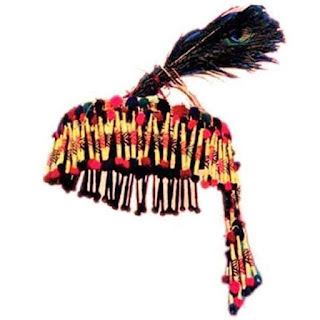
 Kirat Crown Pialokcha/Champhuri

Kirat Bayung Rai's (Hang Shili) original Mundumi clothes...Pialokcha/Champhuri (Kirati crown worn on the head)/Narimokte, Sapachiri, Salama, Kingma, Mulupcha are woven and prepared from the village of Okhaldhunga/Solukhambu in the eastern hills and has come to the UK.


In the next few years, Mundumi/cultural heritages with such originality preserved by our Kirati ancestors are sure to disappear. /Salama/Sapachiri/Kingmas hand weaving arts have not been handed down and learned.


Today even in village houses there are only one or two elders who know such skills, who will give its cultural importance and continuation after their generations? A serious question has come. 


Thus, these original Mundumi cultural costumes preserved by the Kirati ancestors have become extinct. In order to protect the original costumes with such cultural significance,


the young generations should understand their cultural importance and try to protect them. In the ancient Kirat period, all the Kirats used to wear it, then some of the Kirats became geographically and linguistically separated. Preserve original Kirati dress/costumes and heritages ****


Mulghare Kancha

Comments

Popular posts from this blog

history of soi soila "kirat civilization"

 History of Soisoila'  How did the origin of 'Soisoila', a song sung by the Kirantis when they dance Sakela, i.e. the song of Sakela song? Even though a lot of recordings or videos of Sakela songs have been produced, only a few people have tried to find a concrete and authentic answer to this question. It is imperative that the young generation pay attention to the historical search and research of these seemingly small, but seriously related topics with the entire Kirati civilization.   According to Mundum researcher Bhogiraj Chamling, it is important to explain 'Soisoila' in connection with history.  The story of 'Soisoila' is popular in the geography from Sunuwar to Bantwa Rais. According to the Sunuwars, a Kiranti king named Budahopo used to rule in Banepa region. He was an expert in Mundum. When he was king, his dynasty had a golden bird called 'Homa Chiri'. However, when the share was distributed, there was a quarrel between the king and his br...

Kirat are an indigenous People

 1. Kirat or Kirati People : The Kirat are an indigenous ethnic group primarily found in the Himalayan region, particularly in Nepal, as well as in parts of India (Sikkim, Darjeeling) and Bhutan. They have a rich cultural heritage, including their own languages, traditions, and religious practices. The Kirati people are often associated with the ancient Kirat Kingdom mentioned in Hindu texts like the Mahabharata. The Kirat people traditionally follow a form of animism and shamanism, worshiping nature and ancestors. Their religion is called "Kirat Mundhum or Mundum"  and it plays a central role in their cultural identity. The Kirat people are an indigenous ethnic group native to the Himalayas, primarily residing in Nepal, Bhutan, Myanmar and parts of India . They have a rich cultural heritage and a long history in the region.   Kirat religion:- An indigenous animistic religion of Kirati ethnic groups in Nepal. Kirata:- A generic term in Sanskrit literature for people who h...

Kirat Civilization

  The Kirat Civilization: The Legacy The primeval ancestors of the Kirat civilization The Kirat Rai people have considered Tuwa Chung Hill in Khotang district as the place where their ancient civilization began. Kirati women, known as Tayama and Khiyaama (names differing by language), are believed to have woven fabric for the first time on the weaving stone located there. The Mundum (oral scripture of the Kirat people) discovered so far also hints at this belief. Contents: 1 The primeval ancestors of the Kirat civilization Tayama Khiyama 2 Raichhakule The primeval ancestors of the Kirat civilization                                  Tayama Khiyama Tayama (elder sister) , Khiyama (younger sister) and Raichhakule (Tayama and Khiyama’s younger brother) are supposed to be the primeval ancestors of the Kirat civilization. The sisters are believed to have lived in Tuwachung whereas the brother in the cave...